Friday, 13 March 2015

Caenis / Caeneus

Caenis......

In Greek mythology, Caenis was described as the daughter of  Elatus, a Lapith leader and Hippea. In other version, Caenis was described as the daughter of Atrax, the son of the river god Peneus and Bura. 
    
Poseidon and Caenis
     Sea god Poseidon was attracted towards Caenis stunning beauty and lusted after her. Caenis tried to escape Poseidon embraces, but Poseidon forced her to have sexual intercourse with him. Afterwards Poseidon promised to grant her anything she wished. Caenis wished to become a man, so that nothing like this could ever happen to her again.
Poseidon and Caenis
        
                                         Poseidon granted her wish, and in addition, made her/him invulnerable to all weapons.  Caenis then changed his name to Caeneus and became a warrior, traveling all over Thessaly.   Caeneus was among the company of heroes that hunt the Calydomia Boar.
Caeneus............

                                       At the wedding of Pirithous, when fighting broke out between the Lapiths and the Centaurs, Caeneus slew many of the Centaurs but remained unharmed himself.In revenge for this, a mob of centaurs piled pine-tree trunks and stones upon him, since he was immune to weapons.
Centaurs and Caeneus................battle...

 The Centaur could not kill him, and he was crushed or smothered beneath the great weight. After Caeneus death, he fall directly into Tartarus. Other version described that he flew away from the pile of tree trunks as a golden-winged bird.

Index

Thursday, 12 March 2015

Aeacus

                                                                                      In Greek mythology, Aeacus was described as the king of island Aegina and the son of Zeus and Aegina, a daughter of the river-god Asopus. Aeacus was born on the island of Oenone or Oenopia, to which Aegina had been carried by Zeus it the guise of eagle. Latter the island was named Aegina. Aeacus was alone in the island, and since a territory without human beings was worthless for any man living in it, to put an end to that solitude Zeus turned the ants of the island into men. And when human beings were added to the land, Aeacus could become king.
Aeacus and Myrmidons

                                                In other version, island Aegina was not uninhabited at the time of the birth of Aeacus,but jealous Hera, punished the island that had been named after her husband's mistress (Aegina). So a plague fell upon Aegina, attacking first the animals and then the human beings. This epidemic had such proportions that almost no one was left alive, and the dead bodies were so many that no one cared to bury them. It was then that Aeacus prayed to Zeus under an oak. Then the ants turned into men, first in Aeacus' dream that night, but later in reality, for on the following day he could see them with his waking eyes as they came greeting him as king. And because of his prayer and his dream he called them Myrmidons, deriving this name from the word "ant".  

                 Aeacus married first Endeis, and had by her two sons,  Peleus and Telamon . Then Aeacus married the Nereid Psamathe, who turned herself into a seal in an attempt to avoid him, and had by her a son Phocus.  During his rule, Aeacus fortified Aegina, making the island difficult to approach, surrounding it by sunken rocks and reefs. Aeacus became famous for his wisdom, even Zeus would listen to him alone. Aeacus was known for settling disputes even for the gods.

                                                   In some versions,  Apollo and Poseidon took Aeacus as their assistant in building the walls of Troy. When the work was completed, three dragons immediately attacked the city. The two that attacked Poseidon's and Apollo's walls fell down dead almost after they banged into the fortifications, but the third one was able to break through Aeacus' wall and get into the city.  When Apollo had seen this, he predicted that it would be through the hands of a descendant of Aeacus that Troy would be destroyed.
                                         In some versions, after Aeacus death,  he became (along with the Rhadamanthus and Minos) one of the three judges in underworld.

INDEX

Wednesday, 11 March 2015

Calydonian Boar..............The hunt


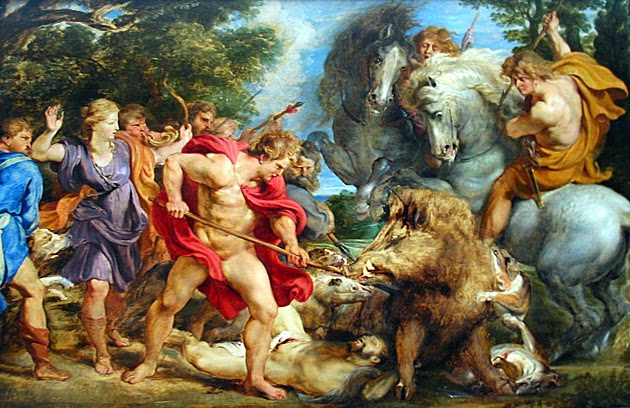
 In Greek mythology, Calydonian Boar was described as the gigantic boar sent by goddess Artemis to ravage the countryside of Calydon to punish King Oineus for neglecting her in the offering of the first fruits to the gods.
Artemis and Calydonian Boar.....

                  In Greek legend, Oeneus, the king of Calydon, held annual harvest sacrifices to the gods on the sacred hill.One year the king forgot to include goddess Artemis in his offerings and in revenge Artemis sent a savage boar which laid waste to the countryside. The king summoned heroes from throughout Greece to hunt down the beast.

                                 Among those who responded were many famous heroes, including some of the Argonauts, Oeneus' own son Meleager, and, one woman, the huntress Atalanta. In some version, it was described that King Oineus' son Meleager organizes a band of heroes to hunt the boar, including the huntress Atalanta.
Calydonian Boar hunt...

                                 
                         In some versions, it was described that goddess Artemis had sent the young huntress because she knew her presence would be a source of division. Many of the men were angry that a woman was joining them, but Meleager, though married, lusted for Atalanta, and so he persuaded them to include her. The hunt itself was a bloody affair, with several men being killed before anyone could even wound the boar.


Meleager Presents Atalanta the head of the Calydonian Boar
                                               Finally, Atalanta injured the beast with an arrow, and then Meleager killed it with his spear. Afterwards, Meleager tried to award the boar's pelt to Atalanta, since he was in love with her and since she had been the first to draw blood in the hunt. However, Meleager's uncles, Plexippus and Toxeus, objected to awarding the prize to a woman, and in the ensuing argument Meleager killed them. Meleager's mother, Althaea, then arranged Meleager's own death in revenge for the deaths of her brothers.

Calydonian Boar Hunters

Acastus-a splendid javelin- thrower,
 Admetus-the son of Pheres, from Pherae
Alcon-one of three sons of Hippocoon or Ares from Amykles in Thrace
Amphiaraus-the son of Oicles, from Argos,
 Ancaeus-from Parrhasia, son of Lycurgus, killed by the boar.
Asclepius  -son of Apollo
Atalanta- also called Tegeaea, the daughter of Skoineus, from Arcadia
Caeneus-son of Elatus,
The Dioscuri- Castor and Pollux, sons of Zeus and Leda, from Lacedaemon
Cepheus - from Arcadia
Cteatus - son of Actor.
Deucalion - son of Minos
Dryas of Calydon- son of Ares 
Echion one of the Argonauts
Epochus
Euphemus - son of Poseidon
Eurypylus
Eurytion - accidentally run through with the javelin of Peleus
Eurytus - son of Hermes
Hippasus - son of Eurytus
Hippothous
Hyleus - killed by the boar
Jason  - Aeson’s son, from Iolkos
Idas and Lynceus - sons of Aphareus, from Messene
Iolaus - son of Iphicles, nephew of Heracles
Iphicles - the twin of Heracles, 
Kometes and Prothous - the sons of Thestios, Meleager's uncles
Laertes - son of Arcesius, 
Lelex - of Naryx in Locria
Leucippus - one of three sons of Hippocoon or Ares from Amykles in Thrace
Lynceus and Idas
Meleager - son of Oeneus
Mopsus - son of Ampycus
Nestor
Panopeus
Peleus - son of Aiakos
Phoenix - son of Amyntor
Phyleus - from Elis
Pirithous - son of Ixion, from Larissa, the friend of Theseus
Plexippus  -brother of Toxeus, slain by Meleager
Polydeuces
Prothous and Kometes - the sons of Thestios, Meleager's uncles
Telamon - son of Aeacus
Theseus -of Athens  AND
Toxeus

INDEX

Tuesday, 10 March 2015

Sisyphus

In Greek mythology, Sisyphus was described as the founder and first king of Ephyra, and the son of Aeolus, king of Thessaly and Enarete.  In some versions, the sorceress Medea  gave Sisyphus the throne of Ephyra, later known as Corinth.  According to other version, Sisyphus earned the crown by founding the city, which he populated with people grown out of mushrooms. 
Sisyphus

                              Sisyphus married Merope , the only one of the seven Pleiades (daughters of the Titan Atlas and Pleione) to have wedded a mortal rather than consorting with the gods. He was the father of Glaucus3, Ornytion, Almus, and Thersander by his wife Merope.  
                                               In the neighbor of Sisyphus , Autolycus a notorious thief, would steal anything he could get his hands on. But Autolycus always escaped detection because he could change the form or color of anything he stole. Autolycus repeatedly stole cattle from Sisyphus’s herd. Sisyphus noticed that cattle were missing and that the herd of Autolycus seemed to be expanding in number, but could not prove any theft.
                                                 In an attempt to catch Autolycus in the act, Sisyphus secretly marked the inside of the hooves of his cattle.  The later discovery of his mark on cows in Autolycus’s herd proved that his neighbor was a thief. In some versions, Sisyphus was not satisfied merely with proving Autolycus a thief and recovering his cattle. Seeking revenge, he seduced Anticleia, the daughter of Autolycus and later the mother of Odysseus. So in some versions Sisyphus was described as the father of Odysseus.
                                         Sisyphus and his brother Salmoneus  hated each other. In some versions, Sisyphus found out from an oracle that if he had children by his brother’s daughter, they would destroy their grandfather. He secretly had sex with Salmoneus's daughter Tyro and she bore him a son. But when she found out what the child would do to Salmoneus, she killed the boy. It was soon after this that Tyro was seduce by sea god, Poseidon, in the guise of the river-god Enipius and bore him Pelias and Neleus. 
                                          As a king Sisyphus promoted navigation and commerce but was avaricious and deceitful. Sisyphus also killed travelers and guests, a violation of Xenia which fell under Zeus' domain. He took pleasure in these killings because they allowed him to maintain his iron-fisted rule.
                          Sisyphus saw Zeus  kidnap a river nymph, Aeginabut he promised to keep the hiding place secret. But Sisyphus betrayed Zeus, however, when he revealed the location to the river god Asopus (nymph's father), in exchange for a spring of pure water. The punishment Zeus inflicted was death.
                                        
                                             When Death (Thanatos) came, Sisyphus tied him up and escaped. This caused an uproar since no human could die with Thanatos disabled. Eventually the god of war,  Ares, who was annoyed that his battles had lost their fun because his opponents would not die, intervened. The exasperated Ares freed  and turned King Sisyphus over to Thanatos as well. In other version, As long as Thanatos was tied up, nobody could die. Because of this, sacrifices could not be made to the gods and those that were old and sick were suffering. The gods finally threatened to make life so miserable for Sisyphus that he would wish he was dead. He then had no choice but to release Thanatos .

Thanatos  again went after Sisyphus. But before Sisyphus went to the Underworld, he told his wife, the Pleiad Meropeto throw his naked body into the middle of the public square and not to bury him, give him a funeral feast, perform any sacrifices to Hades or Persephone, or place a coin under his tongue (which was used to pay Charon, who ferried the dead for passage across the river Styx to the Underworld).
                                     Appealing to Queen Persephone, Sisyphus told her that he had no right to be there. As one of the unburied, who had no fare for Charon, he should have been abandoned on the far side of the river Styx. Furthermore, Sisyphus argued, his wife’s neglect of funeral ceremonies and sacrifices might set a bad example for other widows in the future.


Sisyphus pleaded for permission to return to the surface of the earth for just three days. This brief time would allow him to arrange for his funeral, to punish his wife for neglecting her duties, and to teach her respect for the lords of the Underworld. Persephone fell for his pleas and allowed Sisyphus to go home. Sisyphus, of course, had no intention to return to the world of darkness. He reneged on his promise to descend again in three days. Indeed, he lived many more years until old age claimed him at last.
Sisyphus..................in Tartarus....................

                               For his offenses to Zeus, Persephone and Thanatos, Sisyphus was condemned to eternal punishment in Tartarus, the lowest region of the Underworld. Sisyphus would forever roll a massive boulder to the top of a steep hill. But his efforts were always in vain, for whenever Sisyphus neared the top, the rock would roll right back down again. Sisyphus was thus forced to start his labor all over again.
  

Index

Monday, 9 March 2015

Triton

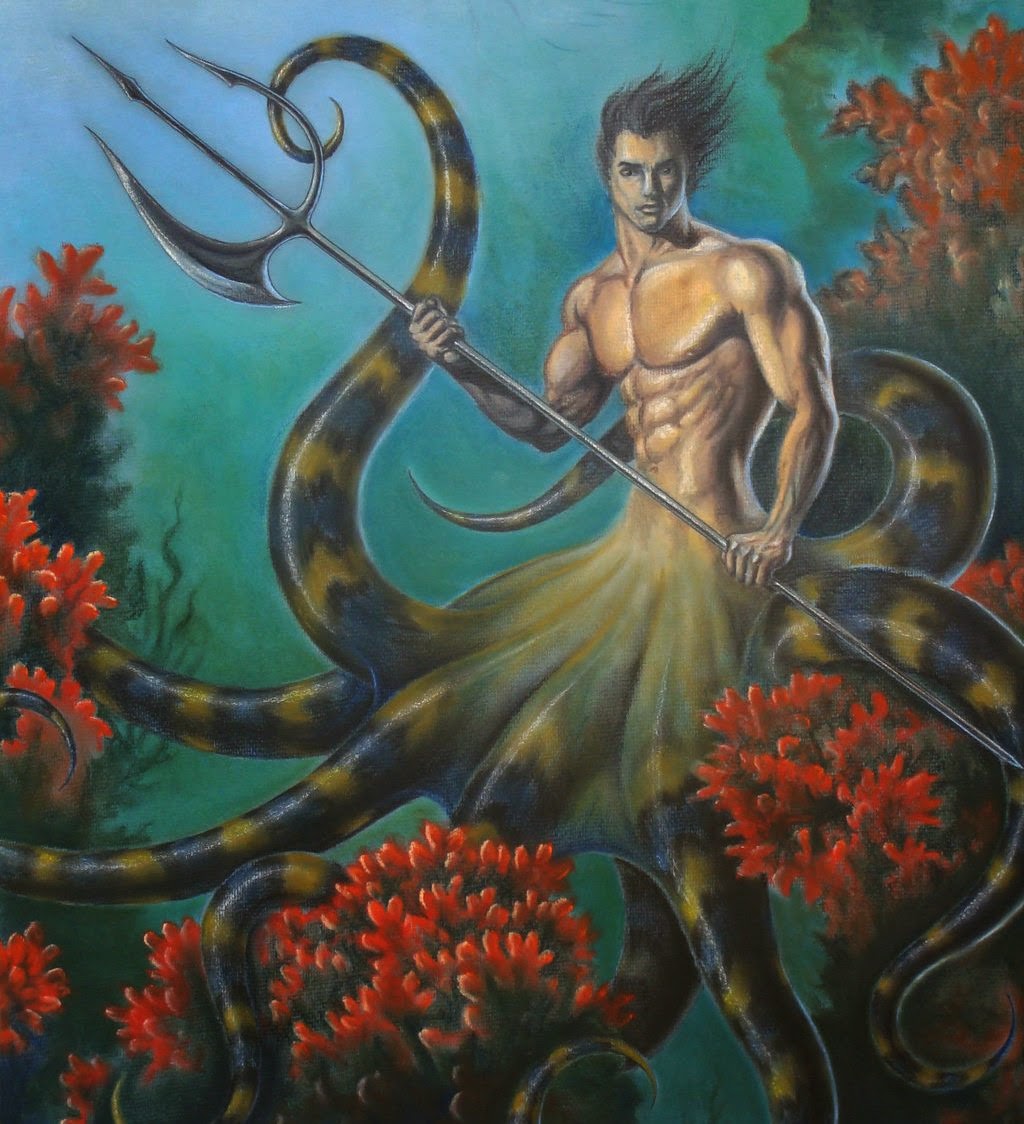
In Greek mythology, Triton was described as the son and messenger of Poseidon, king of the seas, and his wife Amphitrite, queen of the seas. Triton was represented as a merman, having the upper body of a human and the tail of a fish. In some versions, Triton was described to live with his parents, Poseidon and Amphitrite, in a golden palace on the bottom of the sea. 
Triton

                                             Triton was the father of Pallas2 and foster parent to the goddess Athena. Pallas2 was killed by Athena during a friendly fight between the two goddesses. In some versions, Triton was described as the father of Scylla by Lamia.
                         
                               Tritons
                                     
Tritons
              
In Greek mythology, Tritons were described as the mermaid and merman-like creatures, which could be male or female, and usually formed the escort of marine divinities. Tritons were a race of sea gods and goddesses born from Triton. 


INDEX